| Your Y-chromosome results identify
you as
a member of haplogroup R1a1.
The genetic markers that
define your ancestral history reach back roughly 60,000 years to the
first common marker of all non-African men, M168, and follow your
lineage to present day, ending with M17, the
defining marker of haplogroup R1a1.
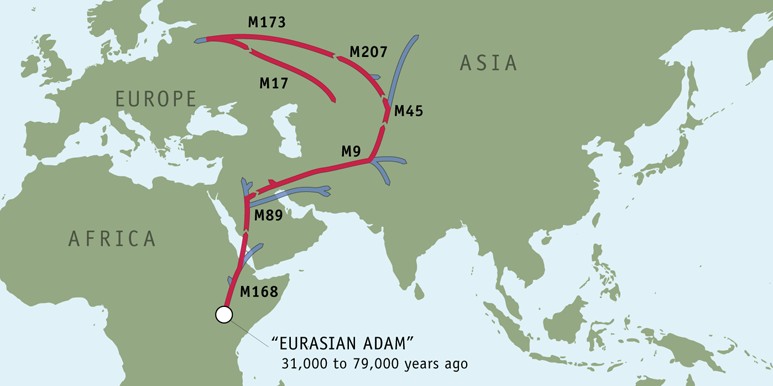
If you look at the map
highlighting your ancestors' route, you will see that members of
haplogroup R1a1 carry the following Y-chromosome
markers: M168
> M89 > M9 > M45 > M207 > M173
> M17 Today a large
concentration—around 40 percent—of the men living
in the Czech Republic across the steppes to Siberia, and south
throughout Central Asia are members of haplogroup R1a1.
In India, around 35 percent of the men in Hindi-speaking populations
belong to this group. The M17 marker is found in
only five to ten percent of Middle Eastern men. The marker is also
found in relatively high frequency—around 35
percent—among men living on the eastern side of present-day
Iran. What's
a haplogroup, and why do geneticists concentrate on the Y chromosome in
their search for markers? For that matter, what's a marker?
Each of us carries DNA
that is a combination of genes passed from both our mother and father,
giving us traits that range from eye color and height to athleticism
and disease susceptibility. One exception is the Y chromosome, which is
passed directly from father to son, unchanged, from generation to
generation. Unchanged,
that is unless a mutation—a random, naturally occurring,
usually harmless change—occurs. The mutation, known as a
marker, acts as a beacon; it can be mapped through generations because
it will be passed down from the man in whom it occurred to his sons,
their sons, and every male in his family for thousands of years.
In some instances there
may be more than one mutational event that defines a particular branch
on the tree. This means that any of these markers can be used to
determine your particular haplogroup, since every individual who has
one of these markers also has the others. When geneticists identify such a marker,
they try to figure out when it first occurred, and in which geographic
region of the world. Each marker is essentially the beginning of a new
lineage on the family tree of the human race. Tracking the lineages
provides a picture of how small tribes of modern humans in Africa tens
of thousands of years ago diversified and spread to populate the world.
A haplogroup is defined
by a series of markers that are shared by other men who carry the same
random mutations. The markers trace the path your ancestors took as
they moved out of Africa. It's difficult to know how many men worldwide
belong to any particular haplogroup, or even how many haplogroups there
are, because scientists simply don't have enough data yet.
One of the goals of the
five-year Genographic Project is to build a large enough database of
anthropological genetic data to answer some of these questions. To
achieve this, project team members are traveling to all corners of the
world to collect more than 100,000 DNA samples from indigenous
populations. In addition, we encourage you to contribute your anonymous
results to the project database, helping our geneticists reveal more of
the answers to our ancient past. Keep checking these pages; as more
information is received, more may be learned about your own genetic
history. Your
Ancestral Journey: What We Know Now M168: Your
Earliest Ancestor Fast Facts Time of Emergence: Roughly 50,000 years ago
Place of Origin: Africa
Climate: Temporary
retreat of Ice Age; Africa moves from drought to warmer temperatures
and moister conditions Estimated Number of Homo sapiens:
Approximately 10,000 Tools and Skills: Stone tools; earliest
evidence of art and advanced conceptual skills Skeletal and archaeological evidence
suggest that anatomically modern humans evolved in Africa around
200,000 years ago, and began moving out of Africa to colonize the rest
of the world around 60,000 years ago. The man who gave rise to the first genetic
marker in your lineage probably lived in northeast Africa in the region
of the Rift Valley, perhaps in present-day Ethiopia , Kenya, or
Tanzania, some 31,000 to 79,000 years ago. Scientists put the most
likely date for when he lived at around 50,000 years ago. His
descendants became the only lineage to survive outside of Africa,
making him the common ancestor of every non-African man living today.
But why would man have
first ventured out of the familiar African hunting grounds and into
unexplored lands? It is likely that a fluctuation in climate may have
provided the impetus for your ancestors' exodus out of Africa.
The African ice age was
characterized by drought rather than by cold. It was around 50,000
years ago that the ice sheets of northern Europe began to melt,
introducing a period of warmer temperatures and moister climate in
Africa. Parts of the inhospitable Sahara briefly became habitable. As
the drought-ridden desert changed to a savanna, the animals hunted by
your ancestors expanded their range and began moving through the newly
emerging green corridor of grasslands. Your nomadic ancestors followed
the good weather and the animals they hunted, although the exact route
they followed remains to be determined. In addition to a favorable change in
climate, around this same time there was a great leap forward in modern
humans' intellectual capacity. Many scientists believe that the
emergence of language gave us a huge advantage over other early human
species. Improved tools and weapons, the ability to plan ahead and
cooperate with one another, and an increased capacity to exploit
resources in ways we hadn't been able to earlier, all allowed modern
humans to rapidly migrate to new territories, exploit new resources,
and replace other hominids. M89: Moving
Through the Middle East Fast Facts Time of Emergence: 45,000 years ago
Place: Northern Africa or
the Middle East Climate: Middle East: Semiarid grass plains
Estimated Number of Homo
sapiens: Tens of thousands Tools and Skills: Stone, ivory, wood tools
The next male ancestor in
your ancestral lineage is the man who gave rise to M89,
a marker found in 90 to 95 percent of all non-Africans. This man was
born around 45,000 years ago in northern Africa or the Middle East.
The first people to leave
Africa likely followed a coastal route that eventually ended in
Australia. Your ancestors followed the expanding grasslands and
plentiful game to the Middle East and beyond, and were part of the
second great wave of migration out of Africa. Beginning about 40,000 years ago, the
climate shifted once again and became colder and more arid. Drought hit
Africa and the grasslands reverted to desert, and for the next 20,000
years, the Saharan Gateway was effectively closed. With the desert
impassable, your ancestors had two options: remain in the Middle East,
or move on. Retreat back to the home continent was not an option.
While many of the
descendants of M89 remained in the Middle East,
others continued to follow the great herds of buffalo, antelope, woolly
mammoths, and other game through what is now modern-day Iran to the
vast steppes of Central Asia. These semiarid grass-covered plains formed
an ancient "superhighway" stretching from eastern France to Korea. Your
ancestors, having migrated north out of Africa into the Middle East,
then traveled both east and west along this Central Asian superhighway.
A smaller group continued moving north from the Middle East to Anatolia
and the Balkans, trading familiar grasslands for forests and high
country. M9:
The Eurasian Clan Spreads Wide and Far
Fast Facts
Time of Emergence: 40,000
years ago Place:
Iran or southern Central Asia Estimated Number of Homo sapiens:
Tens of thousands Tools and Skills: Upper Paleolithic
Your next ancestor, a man
born around 40,000 years ago in Iran or southern Central Asia, gave
rise to a genetic marker known as M9, which marked
a new lineage diverging from the M89 Middle Eastern
Clan. His descendants, of which you are one, spent the next 30,000
years populating much of the planet. This large lineage, known as the Eurasian
Clan, dispersed gradually over thousands of years. Seasoned hunters
followed the herds ever eastward, along the vast super highway of
Eurasian steppe. Eventually their path was blocked by the massive
mountain ranges of south Central Asia—the Hindu Kush, the
Tian Shan, and the Himalayas. The three mountain ranges meet in a region
known as the "Pamir Knot," located in present-day Tajikistan. Here the
tribes of hunters split into two groups. Some moved north into Central
Asia, others moved south into what is now Pakistan and the Indian
subcontinent. These different migration routes through
the Pamir Knot region gave rise to separate lineages.
Most people native to the
Northern Hemisphere trace their roots to the Eurasian Clan. Nearly all
North Americans and East Asians are descended from the man described
above, as are most Europeans and many Indians. M45: The
Journey Through Central Asia Fast Facts Time of Emergence: 35,000
Place of Origin: Central
Asia Climate:
Glaciers expanding over much of Europe Estimated Number of Homo sapiens:
Approximately 100,000 Tools and Skills: Upper Paleolithic
The next marker of your
genetic heritage, M45, arose around 35,000 years
ago, in a man born in Central Asia. He was part of the M9
Eurasian Clan that had moved to the north of the mountainous Hindu Kush
and onto the game-rich steppes of present-day Kazakhstan, Uzbekistan,
and southern Siberia. Although big game was plentiful, the
environment on the Eurasian steppes became increasing hostile as the
glaciers of the Ice Age began to expand once again. The reduction in
rainfall may have induced desertlike conditions on the southern
steppes, forcing your ancestors to follow the herds of game north.
To exist in such harsh
conditions, they learned to build portable animal-skin shelters and to
create weaponry and hunting techniques that would prove successful
against the much larger animals they encountered in the colder
climates. They compensated for the lack of stone they traditionally
used to make weapons by developing smaller points and
blades—microliths—that could be mounted to bone or
wood handles and used effectively. Their tool kit also included bone
needles for sewing animal-skin clothing that would both keep them warm
and allow them the range of movement needed to hunt the reindeer and
mammoth that kept them fed. Your ancestors' resourcefulness and
ability to adapt was critical to survival during the last ice age in
Siberia, a region where no other hominid species is known to have lived.
The M45
Central Asian Clan gave rise to many more; the man who was its source
is the common ancestor of most Europeans and nearly all Native American
men. M207:
Leaving Central Asia Fast Facts Time of Emergence: 30,000
Place of Origin: Central
Asia Climate:
Glaciers expanding over much of Europe and western Eurasia
Estimated Number of Homo
sapiens: Approximately 100,000 Tools and Skills: Upper Paleolithic
After spending
considerable time in Central Asia, refining skills to survive in harsh
new conditions and exploit new resources, a group from the Central
Asian Clan began to head west towards the European subcontinent.
An individual in this
clan carried the new M207 mutation on his Y
chromosome. His descendants ultimately split into two distinct groups,
with one continuing onto the European subcontinent, and the other group
turning south and eventually making it as far as India.
Your lineage falls within
the first haplogroup, R1, and gave rise to the
first modern humans to move into Europe and eventually colonize the
continent. M173:
Colonizing Europe—The First Modern Europeans
Fast Facts
Time of Emergence: Around
30,000 years ago Place: Central Asia
Climate: Ice Age
Estimated Number of Homo
sapiens: Approximately 100,000 Tools and Skills: Upper Paleolithic
As your ancestors
continued to move west, a man born around 30,000 years ago in Central
Asia gave rise to a lineage defined by the genetic marker M173.
His descendants were part of the first large wave of humans to reach
Europe. During
this period, the Eurasian steppelands extended from present-day
Germany, and possibly France, to Korea and China. The climate fostered
a land rich in resources and opened a window into Europe.
Your ancestors' arrival
in Europe heralded the end of the era of the Neandertals, a hominid
species that inhabited Europe and parts of western Asia from about
29,000 to 230,000 years ago. Better communication skills, weapons, and
resourcefulness probably enabled your ancestors to outcompete
Neandertals for scarce resources. This wave of migration into Western Europe
marked the appearance and spread of what archaeologists call the
Aurignacian culture. The culture is distinguished by significant
innovations in methods of manufacturing tools, more standardization of
tools, and a broader set of tool types, such as end-scrapers for
preparing animal skins and tools for woodworking.
In addition to stone, the
first modern humans to reach Europe used bone, ivory, antler, and
shells as part of their tool kit. Bracelets and pendants made of
shells, teeth, ivory, and carved bone appear at many sites. Jewelry,
often an indication of status, suggests a more complex social
organization was beginning to develop. The large number of archaeological sites
found in Europe from around 30,000 years ago indicates that there was
an increase in population size. Around 20,000 years ago, the climate
window shut again, and expanding ice sheets forced your ancestors to
move south to Spain, Italy, and the Balkans. As the ice retreated and
temperatures became warmer, beginning about 12,000 years ago, many
descendants of M173 moved north again to repopulate
places that had become inhospitable during the Ice Age.
Not surprisingly, today
the number of descendants of the man who gave rise to marker M173
remains very high in Western Europe. It is particularly concentrated in
northern France and the British Isles where it was carried by ancestors
who had weathered the Ice Age in Spain. M17: The
Indo-Europeans of the Steppes of Asia Fast Facts Time of Emergence: 10,000 to 15,000 years
ago Place
of Birth: Ukraine or southern Russia Climate: Glaciers are retreating
Estimated Number of Homo
sapiens: A few million Tools and Skills: Possibly the first
people to domesticate the horse Your genetic trail ends with a marker that
arose between 10,000 to 15,000 years ago when a man of European origin
was born on the grassy steppes in the region of present-day Ukraine or
southern Russia. His descendents became the nomadic steppe
dwellers who eventually spread as far afield as India and Iceland.
Archaeologists speculate that these people were the first to
domesticate the horse, which would have eased their distant migrations.
In addition to genetic
and archaeological evidence, the spread of languages can also be used
to trace prehistoric migration patterns. Your ancestors, descendants of
the Indo-European clan, may be responsible for the birth and spread of
Indo-European languages. The world's most widely spoken language
family, Indo-European tongues include English, French, German, Russian,
Spanish, several Indian languages such as Bengali and Hindi, and
numerous others. Many of the Indo-European languages share similar
words for animals, plants, tools, and weapons. Some linguists believe that the Kurgans,
nomadic horsemen roaming the steppes of southern Russia and the
Ukraine, were the first to speak and spread a Proto-Indo-European
language, some 5,000 to 10,000 years ago. Genetic data and the
distribution of Indo-European speakers suggest the Kurgans, named after
their distinctive burial mounds, may have been descendents of M17.
Today a large
concentration—around 40 percent—of the men living
from the Czech Republic across the steppes to Siberia, and south
throughout Central Asia are descendants of this clan. In India, around
35 percent of the men in Hindi-speaking populations carry the M17
marker, whereas the frequency in neighboring communities of Dravidian
speakers is only about ten percent. This distribution adds weight to
linguistic and archaeological evidence suggesting that a large
migration from the Asian steppes into India occurred within the last
10,000 years. The M17 marker is
found in only five to ten percent of Middle Eastern men. This is true
even in Iranian populations where Farsi, a major Indo-European
language, is spoken. Despite the low frequency, the distribution of men
carrying the M17 marker in Iran provides a striking
example of how climate conditions, the spread of language, and the
ability to identify specific markers can combine to tell the story of
the migration patterns of individual genetic lineages. In the western
part of the country, descendants of the Indo-European Clan are few,
encompassing perhaps five to ten percent of the men. However, on the
eastern side, around 35 percent of the men carry the M17
marker. This distribution suggests that the great Iranian deserts
presented a formidable barrier and prevented much interaction between
the two groups. This is where your genetic trail, as we
know it today, ends. However, be sure to revisit these pages. As
additional data are collected and analyzed, more will be learned about
your place in the history of the men and women who first populated the
Earth. We will be updating these stories throughout the life of the
project. |